
Ice Hockey Accumulator Tips for UK Punters
 Available in US
I’ll start with the honest part: most hockey accumulators are bad bets. Not because they can’t win, but because the price you’re getting on a multi-leg bet is almost always worse than the combined price of the same legs as singles, and the variance is wider. That said, accumulators have their place in a UK hockey punter’s portfolio when used deliberately rather than chased reflexively. This guide is about which accumulators are worth making, which aren’t, and how to think about the maths before you click bet.
If you’re approaching accumulators as a way to turn a small stake into a big return with a single good night of analysis, this article is going to disappoint you. If you’re looking for a clear-eyed view of when accumulators offer genuine value and when they’re recreational entertainment dressed as strategy, you’re in the right place.
Table of Contents
- The Maths That Defines the Accumulator
- The Independence Assumption
- When Accumulators Actually Make Sense
- Popular UK Accumulator Formats
- Correlation Risk in Hockey Accumulators
- Mixed-League Accumulators
- Acca Insurance and Boost Offers
- How I Actually Use Accumulators
- What Accumulator Discipline Looks Like
- Common Questions on Hockey Accumulators
The Maths That Defines the Accumulator
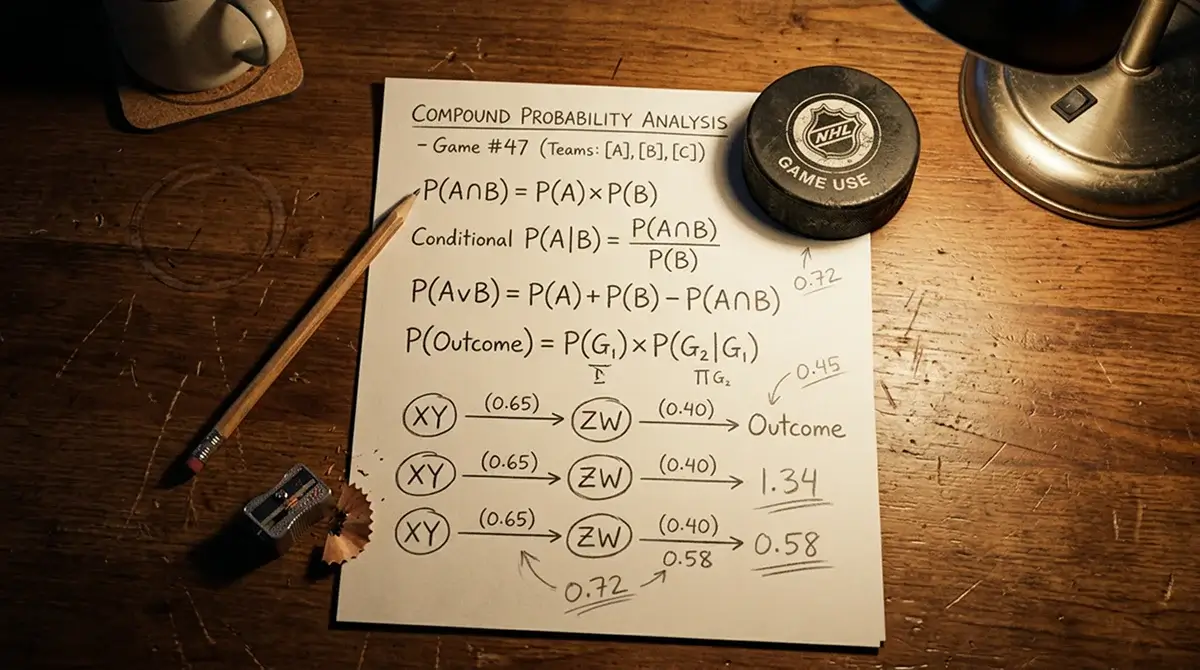
An accumulator combines multiple selections into a single bet that pays out only if every leg wins. The combined odds are the product of each individual leg’s decimal odds, which produces the headline appeal — five 1.80 selections combine to roughly 18.9, turning a £10 stake into £189 if all five land.

The catch is the maths underneath. Each leg has its own implied probability — a 1.80 selection implies a 55.6% chance of winning. Across five independent selections at 1.80 each, the combined probability of all five winning is about 5.3%. The fair price for that combination would be 18.9 decimal, which is what the accumulator pays. The bookmaker’s margin is baked into each individual leg, so when those margins compound across multiple legs, the cumulative cost rises sharply.
Across US sportsbooks in 2025, the combined hold across all sports was 10.15% on $165.58 billion of handle. Parlay-style bets typically carry materially higher hold than singles — often double or triple the single-bet margin — because the bookmaker captures their cut on each leg and compounds across the whole bet. That’s the structural cost of an accumulator: you’re paying multiple margins for one ticket.
The Independence Assumption
Standard accumulator pricing assumes each leg is independent — the outcome of game A doesn’t affect the outcome of game B. For multi-game hockey accumulators using moneylines on different fixtures, that assumption is mostly true. The outcome of one Colorado Avalanche game has minimal impact on the outcome of a Boston Bruins game played later the same night.
Where independence breaks down: same-game parlays. The legs are correlated. A Toronto Maple Leafs win is correlated with Toronto goals being scored. The over correlates with both teams scoring. A team holding a third-period lead is correlated with under team-total props for the trailing team. Same-game parlays handle correlation differently from sportsbook to sportsbook, with most modern operators now using correlated-leg pricing models rather than treating legs as independent. The price you see should reflect those correlations, but how accurately varies between books.
For multi-game accumulators, the independence assumption is mostly fine. For same-game parlays, never assume independence — always check whether the price seems to reflect the correlation between your selected legs, and if it looks artificially attractive, the book has probably mispriced the correlation in their favour. The principles behind NHL same-game parlay betting apply here at full weight.

When Accumulators Actually Make Sense
Despite the structural cost, accumulators have legitimate uses for UK hockey punters. The cases where they work:
First, when you have multiple genuine positive-expected-value bets and you want to express conviction across them with a combined position rather than separate singles. If each leg is +EV individually, the accumulator is +EV in aggregate, even after the compounding hold cost. The bet is larger and higher-variance than the singles would be, but the underlying value is real.
Second, when you’re betting for entertainment value rather than maximised expected return. A £5 accumulator that pays £200 if it lands gives you genuine entertainment across an evening of hockey watching, even if the expected value is slightly negative. As long as the stake is appropriately small and the activity is entertainment-funded rather than analysis-driven, the bet doesn’t need to be the most efficient use of your money.
Third, when promotional offers — boosted accumulator odds, acca insurance, parlay-specific boosts — improve the effective price enough to overcome the compounded hold. UKGC-licensed sportsbooks regularly run promotional accumulator offers, and the ones that genuinely improve expected value are worth taking selectively. The ones that look generous but contain restrictive terms (minimum odds requirements, leg count requirements, market restrictions) often don’t actually improve the price you’d get from analytical singles.
Popular UK Accumulator Formats
The accumulator formats most common at UK sportsbooks for hockey include doubles, trebles, four-folds, five-folds and longer multiples, plus structured systems like Yankees, Trixies and Lucky 15s.
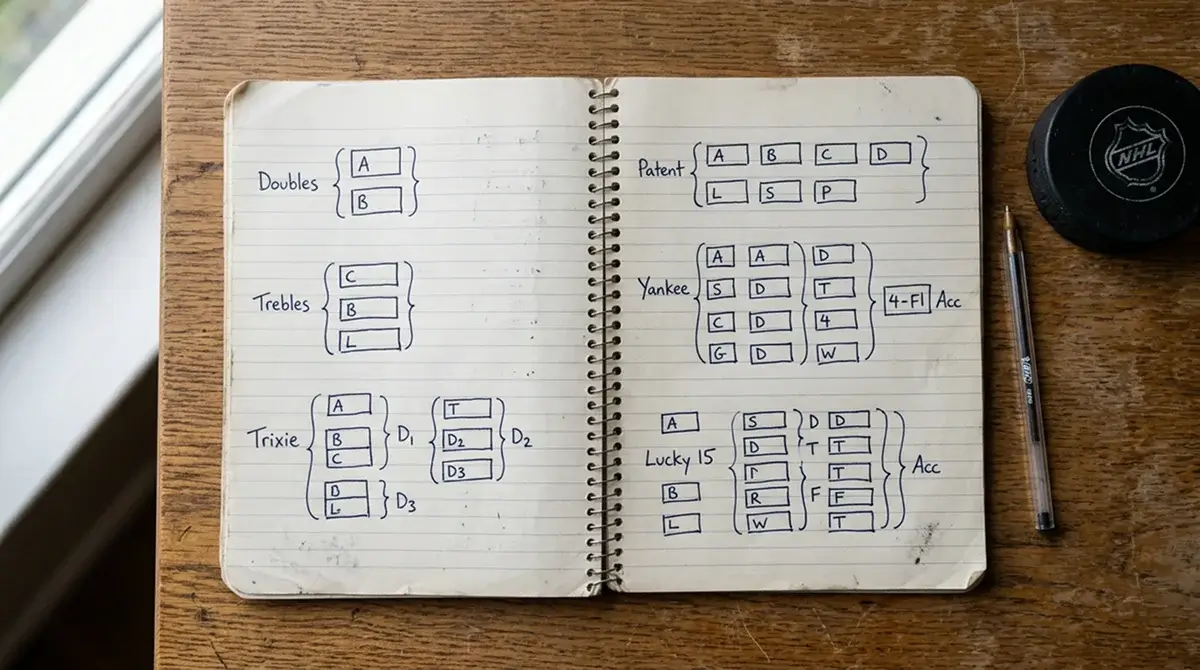
Doubles and trebles are where accumulator value most often appears. The compounded hold across two or three legs is manageable, the combined probability is still meaningful, and the variance isn’t excessive. A treble of three +EV singles at decent odds produces a bet with real potential return and a realistic chance of cashing.
Four-folds and longer multiples compound the hold and variance to a point where the structural cost dominates analytical value. Even if every selection is +EV, the math on a six-fold accumulator typically requires substantial individual edges to overcome the cumulative bookmaker margin. Most six-folds and longer multiples are -EV unless built around boosted prices or specific value angles.
Lucky 15s place multiple permutations of four selections as 15 separate bets. The structure reduces variance compared to a pure four-fold by allowing partial cashes, but it costs 15 stakes for the privilege. The maths usually doesn’t favour these systems compared to placing the legs as efficient singles.
Correlation Risk in Hockey Accumulators
The trap UK punters fall into most often: building accumulators across hockey selections that are more correlated than the price assumes.
Examples of hidden correlation in hockey accas: backing the over in multiple games on the same night, where league-wide scoring patterns tend to cluster (high-scoring nights tend to be high-scoring across all games due to officiating tendency, fatigue patterns or pace-of-play factors); backing several home favourites on a night where most home teams are expected to win, but where unexpected travel patterns or weather factors affect them all; combining EIHL and NHL selections on the same evening, where they’re not directly correlated but share weather and information-access patterns.

The cleanest accumulators are built from selections that are genuinely independent — different leagues, different days, different market types. A hockey accumulator that combines an NHL moneyline tonight with an SHL puck line tomorrow with a Liiga total the day after is structurally independent, and the maths works as the price implies. A hockey accumulator that combines five overs on the same NHL Saturday night is more correlated than the price reflects, and the bet is structurally worse than the offered odds suggest.
Mixed-League Accumulators
The argument for mixed-league hockey accumulators — combining selections from NHL, EIHL, SHL, Liiga, DEL or other competitions — has both an attraction and a complication.
The attraction: structural independence. A bet on Sweden’s Frölunda has no correlation with a bet on the Pittsburgh Penguins. The accumulator math operates as the price suggests, with no hidden correlation reducing your actual probability below the implied probability.
The complication: information access. Building an accumulator across leagues you don’t all follow closely typically produces selections of varying quality. The NHL leg might be analytical; the DEL leg might be a flyer. The compound effect of one weak leg in an otherwise strong accumulator is severe — that one leg drags down the entire bet’s expected value disproportionately. If your DEL knowledge is shallow, adding a DEL leg to your NHL accumulator weakens the bet rather than strengthening it.

The discipline that works for mixed-league hockey accumulators: only include legs from leagues you follow seriously enough to evaluate independently. If you’re a strong NHL bettor with moderate SHL knowledge and weak Liiga knowledge, your accumulators should be NHL-and-SHL only, not three-league combinations that include Finnish hockey you don’t actually know.
Acca Insurance and Boost Offers
UK sportsbooks regularly offer acca insurance — promotional terms that refund your stake if exactly one leg of an accumulator loses while all others win. The offer sounds generous and is sometimes genuinely valuable, but the maths depends on the specific terms. A minimum-odds restriction of 4/5 per leg (1.80 decimal) is more restrictive than it sounds, because it excludes the moderate-favourite legs that often drive successful accumulators. Read the terms before structuring the bet around the promotion.
Boosted-accumulator promotions, where the bookmaker enhances the combined odds beyond the natural multiplication of the legs, can be genuine value when applied to selections you’d already be betting. The most common version: a “five-fold price boost” that adds 25% to the combined odds if all five legs win. That’s a meaningful improvement on expected value, provided you’d already analytically support the underlying selections.
The trap: building accumulators specifically to qualify for the promotion when the underlying selections don’t independently warrant the bet. A five-fold built to qualify for an acca-boost offer is only valuable if the five legs would each have been good bets at their original prices.
How I Actually Use Accumulators
My personal pattern with hockey accumulators across a typical week: maybe one accumulator per fortnight, built from two or three genuinely strong reads I’d back as singles anyway. The bet doubles as recreational entertainment and as an expression of conviction across selections I think the market has mispriced.
I don’t chase accumulators after losing nights. I don’t build them around boosted-odds promotions that contain restrictive terms. I don’t include legs from leagues I don’t watch carefully. The accumulators that work for me look boring on the bet slip — three NHL games on a Saturday night, all moderate favourites, all underpinned by separate analytical reads.
What Accumulator Discipline Looks Like
The UK punters who do well with hockey accumulators across multiple seasons share a few patterns. They size accumulators smaller than their typical singles, recognising the variance is wider. They build them from selections they’d individually back, not from leg-count requirements. They use promotional offers selectively, not as bet-structuring incentives. They track their accumulator results separately from their singles, so they can evaluate the strategy honestly without conflating it with their broader betting performance.

If you’ve been betting accumulators casually for a while and haven’t tracked the results, the first step is honest accounting. Add up the stakes and the returns across all your accumulators for the last twelve months. The number will probably surprise you, in one direction or the other. That data point is the basis for deciding whether to keep going with the same approach, adjust it, or treat accumulators as pure recreation and budget them accordingly.
Common Questions on Hockey Accumulators
Selectively. Doubles and trebles built from genuinely positive expected-value singles can be effective bets. Longer multiples compound the bookmaker’s margin to a point where the structural cost typically dominates analytical value unless promotional offers materially improve the effective price. A regular accumulator combines selections from different games, which are mostly independent of each other. A same-game parlay combines selections from one match, where the legs are correlated, and the price should reflect that correlation. Same-game parlays require different evaluation than multi-game accas. Read the full terms before structuring bets around them. Genuine acca insurance can add meaningful expected value to accumulators built from independently strong selections, but restrictive minimum-odds requirements or market exclusions often reduce the actual benefit compared to the headline offer.Are hockey accumulators worth placing?
What is the difference between a regular accumulator and a same-game parlay?
How should UK punters use acca insurance offers?
Created by the ”ice Hockey Betting” editorial team.