
NHL Same-Game Parlay Betting Guide
 Available in US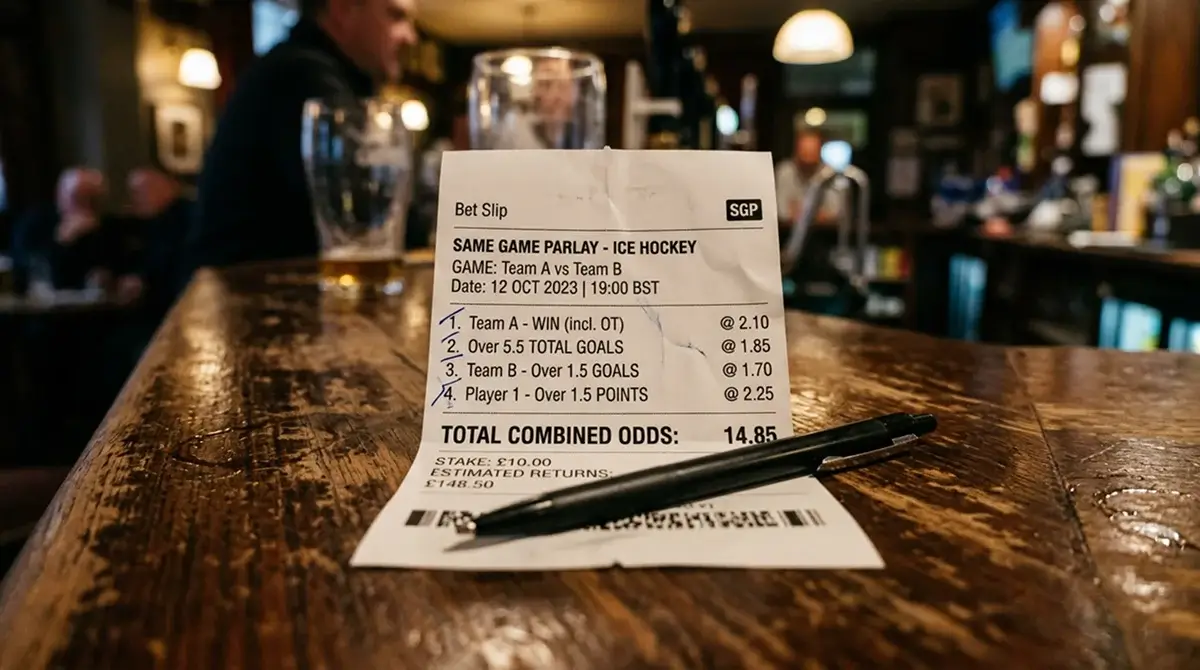
The product UK books cannot stop pushing
If you have noticed an avalanche of “SGP Boost” banners across UK sportsbook apps lately, you are not imagining it. Same-game parlay has become the headline product on NHL coverage for a reason that has very little to do with helping punters and everything to do with margin. The maths are simple: bundle two or more bets from a single game into one ticket and the book gets to compound its hold across the legs.
I have spent a lot of time deconstructing SGP pricing across UK books, and the conclusion is uncomfortable: most SGP tickets are heavily juiced and most punters do not realise they are paying 15-25% combined hold for the privilege. The product is not unwinnable, but it is harder than it looks, and the marketing carries far less critical examination than it should.
This guide unpacks how SGP pricing actually works, the difference between correlated and uncorrelated legs, popular NHL SGP combinations, the real house edge and the trap of SGP boosts. It is a less flattering view of the product than UK promotional content tends to offer, but it is the honest one.
How SGP pricing differs from a standard parlay
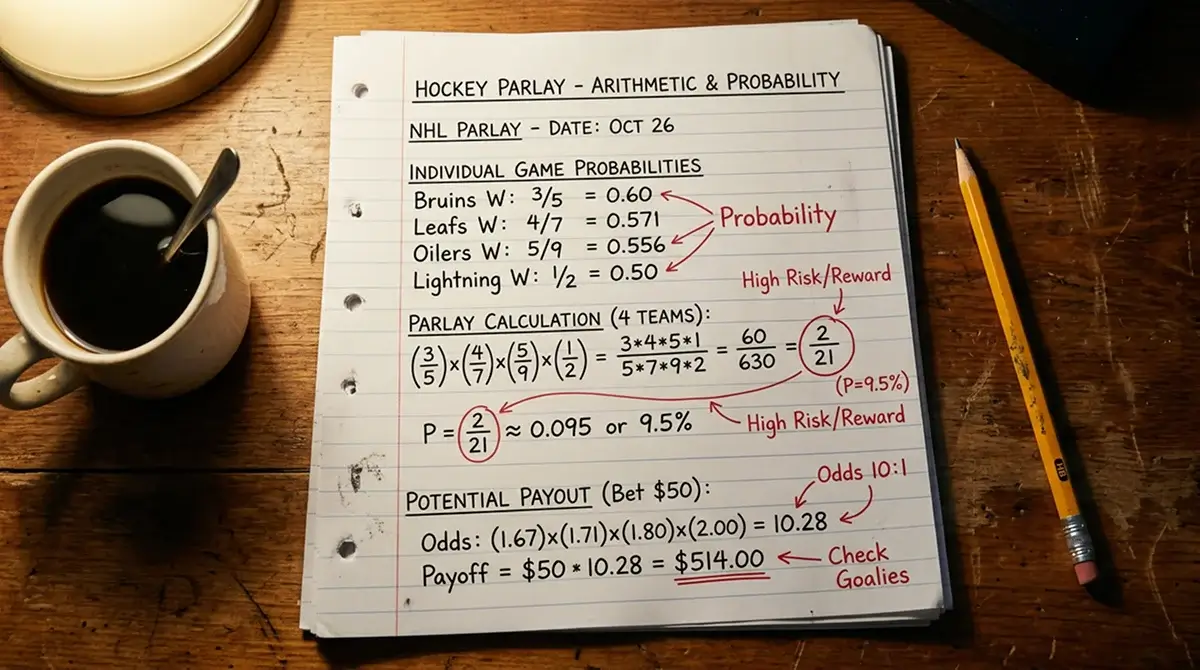
A standard multi-game parlay multiplies the decimal odds of each independent leg. Three games at 1.91 each give you 1.91 × 1.91 × 1.91 = 6.97 decimal odds for the parlay. Subtract the juice baked into each individual leg and the book holds about 13.5% on a three-leg parlay where each leg held 4.5%.
Same-game parlay does not work that way. The legs are not independent — they come from the same game, so the outcome of one affects the others. If Team A wins, the probability of Team A’s top forward scoring goes up. Books cannot just multiply the legs as if they were unrelated, so they apply correlation models that either inflate or deflate the parlay price depending on how the legs interact.
The compounding effect of live betting on hockey markets matters here. With more than 60% of US regulated sportsbook handle flowing through in-play markets, books have ample post-puck-drop opportunity to recoup any pre-match generosity on correlated SGPs. The mathematical pressure to price aggressive pre-match SGPs has eased considerably as the live market grows — which means SGP juice has tightened on the most-bet combinations and widened on the niche ones that books cannot easily hedge in-play.

Correlated and uncorrelated legs
The most important concept in SGP betting is correlation. Two legs are positively correlated when winning one makes the other more likely. Team A to win and Team A’s top forward to score are positively correlated. Two legs are negatively correlated when winning one makes the other less likely. Team A to win and opposing goaltender over 32.5 saves are negatively correlated — a winning Team A typically produces a busy opposing goaltender, but a heavy Team A win produces a buried opposing goaltender who concedes goals against shots.
Books price positive correlation lower than the raw multiplication would suggest, because they recognise the inflated probability of both legs landing together. They price negative correlation higher, because the conjoint probability is genuinely lower. The honest test of an SGP price is: does the quoted decimal odds reflect the correlation, or does it overcharge for it?
The unfortunate answer in most UK SGP markets is that books overcharge. The juice on a correlated three-leg SGP often sits at 15-18%, sometimes more, and the punter has no easy way to verify the fair price. The cleanest way to spot a bad SGP price is to compute the same legs as a non-SGP straight parlay (which the book will allow for legs across different games) and compare. If the SGP price is meaningfully shorter than the equivalent non-SGP parlay would have been with independence assumed, the correlation adjustment is in the book’s favour rather than yours. For the underlying prop pricing that feeds SGP legs, see the ice hockey player props guide.

Popular NHL SGP combinations
The most commonly bet NHL SGPs across UK books cluster in three patterns. The “favourite stack” combines moneyline favourite, top-line forward to score, and game over the total. The “underdog dream” combines moneyline underdog, longshot scorer prop, and game over the total. The “goalie hedge” combines moneyline favourite, top-line forward to score, and starting goalie under saves total.
The favourite stack is the most public-friendly and the most heavily juiced. A 1.50 favourite paired with a 2.40 anytime goalscorer and a 1.91 over the total should price at roughly 6.88 decimal as a non-correlated parlay. The typical UK SGP price is 4.50-5.00 — that is the correlation adjustment, and it pulls the implied probability from 14.5% up to 20-22%. The book is right that the legs are correlated. The book is also taking a margin you may not notice.
The underdog dream is where I see the most punter losses. The marketing displays five-figure potential payouts on £5 stakes, and the legs feel exciting. But longshot props compound rapidly, and the resulting implied probability is genuinely tiny. A four-leg underdog SGP with each leg implied at 30% has a true conjoint probability of about 8% — and the quoted price often implies 5-6%. The product is sold on emotional appeal, not on edge.

The SGP house edge in practice
The market reality is that UK online sports betting generated £2.6 billion in gross gambling yield for the financial year ending March 2025, with football taking £1.3 billion and horse racing £766.7 million. Hockey is a small slice of the remainder, but the hold margins on hockey SGPs sit comfortably above the average — books happily run 12-15% on hockey SGPs because the volume is thinner and the competitive pressure to tighten margins is lower than on football or NFL.
Translating that hold into expected return: a punter consistently placing three-leg NHL SGPs at typical UK pricing should expect to lose around 13-15% of their staked volume over a long sample. That is roughly three times the hold on a standard two-way moneyline ticket. The covers.com team made a point that I think applies precisely here: “Hockey betting isn’t as popular as some of the other major sports, but the edges on the ice are limitless, with a plethora of ways to get in on the action.” The edges exist, but SGPs are not the place to find them at retail UK juice.
There is one exception. SGP combinations that the book has not modelled efficiently — typically niche combinations involving multiple prop legs across different categories — sometimes carry juice closer to 8-10%. If your thesis legitimately requires three or four legs to express, and you have checked the correlation pricing against your own model, SGPs can be the right vehicle. But that is the disciplined use case, not the default.
The boost trap and how it works
UK books market “SGP Boosts” aggressively — typically a small percentage uplift on a pre-built SGP, advertised as a free value enhancement for the punter. The maths look attractive: a 6.00 SGP boosted to 7.50 is a 25% odds increase, which sounds like genuine generosity.
What the marketing does not show is the starting juice. A typical pre-built SGP boost starts from a heavily juiced base — often a parlay with 18-22% combined hold. A 25% odds boost on top of that base reduces the effective hold to roughly 0-5%, which is competitive but not exceptional. The boost is not generating positive expected value; it is bringing a bad price closer to a fair one.
Boosted SGPs also tend to feature specific combinations that the book has selected for its own reasons. Often those combinations include legs where the book has the strongest internal models, or legs designed to attract action toward the book’s preferred exposure. The boost is not the gift the marketing implies — it is a managed promotion.

The disciplined SGP punter
SGPs are not unwinnable, but they require treating the product like a focused expression of a specific match thesis rather than a routine accumulator. Two questions before placing any SGP ticket: would I make these same bets as individual stakes if I had to, and is the correlation pricing in my favour or the book’s? If either answer is no, the SGP is not the right vehicle.
The 12-15% hold on a typical hockey SGP is a brutal headwind. Beating that requires either genuine correlation arbitrage (rare and book-dependent) or a thesis that genuinely requires multi-leg expression and beats the juice. Casual SGP play feeds the book — focused, infrequent SGP play with checked correlation is a different game entirely.
Why is an SGP on the same NHL game cheaper than a parlay across two games?
Books apply a correlation adjustment to SGP pricing because legs from the same game are not independent. Positive correlation between legs (e.g. team to win plus top forward to score) pulls the conjoint probability higher than independence would suggest, so books shorten the price accordingly. The cross-game parlay treats each leg as independent and multiplies the decimal odds directly, producing a longer price even though the true probability may be similar.
Do UK sportsbooks adjust SGP correlation for top-line vs fourth-line scoring legs?
Most UK books apply different correlation weights based on the player’s deployment. A top-line forward paired with team-to-win has a high correlation adjustment because the player drives team scoring. A fourth-line forward paired with the same team-to-win leg has a much lower correlation adjustment because their goal-scoring is less tied to overall team output. The result is that top-six skater SGPs price shorter than bottom-six skater SGPs against the same moneyline leg.
Are SGP boosts on Stanley Cup playoff games worth taking at face value?
Generally no, even though the headline numbers look attractive. Playoff SGP boosts often start from a heavily juiced base parlay, and the boost percentage typically brings the effective hold from 18-22% down to 5-10% rather than into genuine positive territory. The boosted price is closer to fair than the unboosted price, but it is rarely the kind of edge a punter could not find elsewhere on the board with cleaner standalone bets.
Written by the editors at ice Hockey Betting.