
NHL Goaltender Analysis for Bettors
 Available in US
The most tradable variable in hockey
“Most of the time I’d say that a goalie, at most, is worth 3 to 5%.” That was Karry Shreeve, head of hockey at Caesars Sportsbook, putting a number on what the entire industry knows and what most UK punters still misunderstand. The starting goaltender is the single biggest tradable variable in hockey markets, and the books have priced this for years. The opportunity for the punter is not in beating the book on whether goalies matter — it is in the timing window between when news breaks and when the line updates.
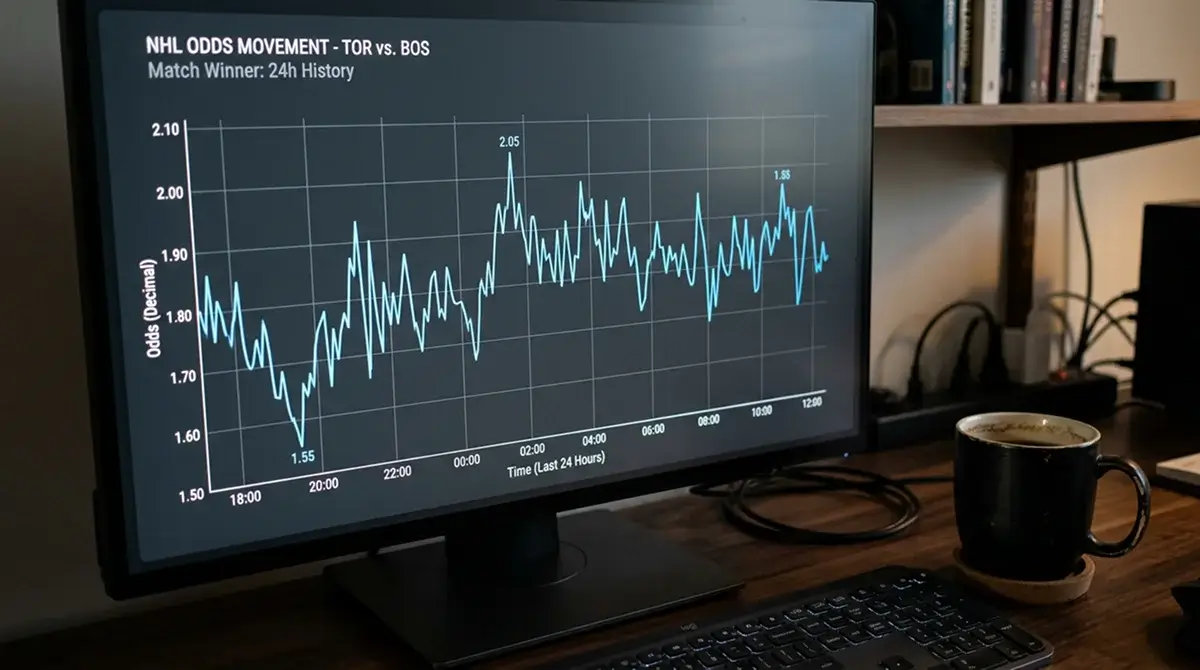
Nine years of tracking NHL line movement has taught me that goaltender confirmation is the highest-frequency edge UK punters can capture if they are willing to do the work. The 3-5% implied probability shift Shreeve quoted maps onto a price move from 1.65 to about 1.85, or from 2.20 to 2.45 on a slightly different starting line. Those are not invisible adjustments — they are the difference between a winning and losing long-term ticket on the same matchup.
This guide covers confirmed-starter timing, the goaltender implied probability shift, advanced metrics beyond save percentage, tandem split scenarios and where to find the news that drives all of it.
Confirmed starter against projected starter
Books open NHL game lines hours before puck drop based on projected starters — typically derived from coaching staff patterns, recent rotation, and back-to-back fatigue. Those projections are usually right but not always, and the difference between a projected starter and a confirmed starter is the trading window. Confirmed-starter news typically lands during morning skates (around 6-8 PM UK time for a typical NHL evening game) and then again at warm-ups about 30 minutes before puck drop.
Morning skate news tends to confirm what the projection assumed — a starter takes most of the practice reps, a backup runs minimal drills. When morning skate produces a surprise (the projected backup is taking starter reps), the line begins to move. The full move usually completes after a coach’s media availability or a confirmed starter graphic on team channels. Books move conservatively until they have firm signal.
Warm-up news is the more decisive window. The starting goalie takes warm-up first; the backup takes a brief skate after. If the public-facing projection had a different goalie penciled in, the discrepancy becomes immediately visible. UK punters watching live coverage in the late evening have a small but real timing edge — books in the US update faster on the news, but UK punters paying attention can sometimes catch a stale price on smaller operators by a few minutes.

The implied probability shift in numbers
The 3-5% figure that Shreeve quoted is the headline, but the distribution is uneven. “No player in hockey is worth too much more than 5 percent” was his framing of the upper bound, and that ceiling is important: even an elite Vezina-quality goalie versus a third-string AHL call-up does not produce more than a 5-6% implied probability swing in most situations.
What varies is where in that range a particular swap lands. A confirmed top-tier starter replacing an average backup produces something near the top of the range — 4-5%. A confirmed backup replacing a confirmed starter produces something nearer to 3-4%. A confirmed tandem-split (both goalies have been splitting starts roughly evenly) produces the smallest move, maybe 1-2%, because the book had already priced in the uncertainty.
The maths on the moneyline: a favourite at 1.65 has 60.6% implied probability. Strip 4% to 56.6% and the price moves to 1.77. Add 4% to 64.6% and the price moves to 1.55. Those numbers translate to puck line, totals and props in different ways — but the directional logic is the same. The goalie change is the most leveraged information event in hockey markets, and the punter who acts on it before the book finalises the adjustment captures the gap.
Advanced goaltender metrics
Save percentage is the headline number, but it is a noisy signal at small sample sizes. Save percentage stabilises only after roughly 1,500-2,000 shots faced — which is approximately one and a half NHL seasons for a typical starter. Early-season Sv% is largely noise, and any conclusion drawn from a goalie’s first 200-300 shots faced is almost certainly an over-extrapolation. For the full treatment of this stabilisation question, see the save percentage sample size guide.
The metrics that hold up better at small samples are derived ones. Goals Saved Above Expected (GSAx) compares actual saves to expected saves given the quality of shots faced, normalised against league-average performance on the same shot types. A goalie with strong GSAx is genuinely stopping more pucks than the shot quality predicted, which is a more honest measure of recent performance than raw Sv%.
High-danger save percentage is the other metric I track more than overall Sv%. Books increasingly price goaltenders on their performance against quality chances rather than total volume — a goalie facing 35 shots a night with low average quality looks busy but is doing easier work than a goalie facing 22 shots with high average quality. High-danger Sv% strips out the easy work and focuses on the meaningful tests. A goalie with strong overall Sv% but weak high-danger Sv% is often a regression candidate.

Tandem splits and back-to-back nights
Many NHL teams operate goaltender tandems rather than clear starter/backup hierarchies. Tandems split starts roughly evenly across a season, often with rest-based or matchup-based rotation logic. The implication for punters: pre-match starter projection is genuinely uncertain on tandem teams, and the price reflects that uncertainty by sitting in a wider band than for clear-starter teams.
Back-to-back nights amplify this. The rested team’s goaltender typically starts; the team coming off the previous night’s game often rests their starter and gives the backup the start. This creates predictable goalie matchups that the books have priced for years, but the timing of the official confirmation still produces small windows of opportunity. The exact rotation pattern varies by team, and tracking these patterns through a season produces a meaningful edge on back-to-back nights.
The most tradable tandem situation is when the rotation breaks expectations. A team coming off a heavy travel back-to-back might start their tandem #1 despite the projection assuming the backup. That confirmation, once it lands, produces an immediate price tightening on the favourite that the disciplined punter can sometimes catch.

Where to find starter news
UK punters need reliable sources for goaltender news because the timing of the information drives most of the edge. The hierarchy of sources I rely on, in order of speed: team beat reporters on social media, official team accounts, official NHL accounts, sportsbook line movement itself (which sometimes broadcasts the news indirectly through price adjustment), and traditional NHL coverage outlets.
Beat reporters are typically the fastest and most accurate source. They are in the building during morning skates, they have direct access to coaches and players, and they tweet confirmed starters within minutes of receiving the information. Following a curated list of team beat reporters across all 32 NHL clubs is the single most effective news-gathering setup for a serious NHL punter. Official team accounts confirm slightly later but more reliably.
The 95% home-betting share of UK online gambling has produced a generation of punters who treat live news monitoring as part of the betting setup itself. A second screen showing curated NHL beat reporter feeds during the late-evening pre-match window is a practical workflow that materially improves capture rate on goalie news. The mobile-heavy 18-24 year-old cohort tends to rely on aggregated social media for news, which is fast but more error-prone than curated reporter lists.

The discipline of treating goalies as variables
The framework that ties this together: treat the starting goaltender as the single biggest variable input to any NHL bet, check it before placing any pre-match ticket, and re-check it at warm-ups for any market that allows late entry. The 3-5% implied probability shift is the price tag of getting this right, and over a long sample it compounds into a meaningful contribution to overall returns.
The discipline is unglamorous: open the beat reporter feed, find the team’s tweet, confirm the starter, place the bet. Two minutes of work that captures more value than any analytical exercise I have run across nine years of NHL coverage.
How much earlier should a UK bettor watch warm-up reports to lock in goalie-priced lines?
Morning skate confirmations land between 6 PM and 8 PM UK time for a typical NHL evening game, and warm-up confirmations come about 30 minutes before puck drop — roughly 11:30 PM UK time for a midnight start. The morning skate window is the better entry point for value because books are slower to react then; the warm-up window catches the final confirmation but the line typically tightens within minutes of the news landing publicly.
What is high-danger save percentage and why does it matter more than overall Sv%?
High-danger save percentage measures the goaltender’s stop rate on shots from high-probability scoring areas, typically defined by location and shot type. Overall Sv% lumps all shots together, including low-quality shots from outside the dot circles that any NHL goalie stops at near-100%. High-danger Sv% strips out the easy work and focuses on the genuinely difficult chances, which makes it a more honest indicator of skill and a less noisy signal at smaller sample sizes.
Does the backup’s recent form change a confirmed-starter game’s price?
Marginally, yes. A backup with strong recent performance reduces the implied probability swing of any in-game injury or pull, because the book knows the backup is competent. A backup with weak recent form increases the tail risk for the favourite. Most UK books incorporate backup quality into their pre-match models, but the adjustment is typically 0.5-1% of implied probability rather than the 3-5% swing from a starter change.
Published by the ice Hockey Betting team.