Bankroll Management for Hockey Betting
 Available in US

Nine years into this and the single biggest predictor of whether someone I know is still betting hockey by year three has nothing to do with their reads on goaltenders or their grasp of expected goals. It’s whether they had a bankroll plan written down somewhere on day one. The bettors who survive the rough patches — and an 82-game NHL regular season guarantees several — are almost always the ones who decided in advance how much they could lose, how big each stake would be, and what would trigger a reset. The ones who didn’t, didn’t last.
Hockey is unusually punishing on undisciplined money. Variance is high, samples are smaller than football, and the favourite-longshot bias on totals means even a sharp read can lose four times in a row. If your staking plan can’t survive that, your edge never gets a chance to show up.
Table of Contents
- Why Hockey Bankroll Rules Differ from Football
- Setting the Bank: What You Can Actually Afford to Lose
- Unit Sizing for Hockey Bettors
- The Kelly Question
- Tracking and the Numbers That Actually Tell You Something
- Drawdowns, Resets and Stop-Loss Rules
- How Discipline Looks in Practice
- Questions Bettors Ask About Hockey Bankrolls
Why Hockey Bankroll Rules Differ from Football
I lost a fortnight’s worth of stakes in February 2023 betting NHL unders during a stretch where every game seemed to land at 6.5 or higher. The reads were fine. The bankroll structure wasn’t, because I was sizing like a football bettor — 3% to 4% per pick, comfortable with three or four bets on a card. Hockey punished that immediately.

The structural difference matters. The UK online sports market produced £2.6 billion in gross gambling yield in the financial year 2024-25, with football alone accounting for £1.3 billion of that. Football’s depth — leagues across continents, dozens of markets per match — lets recreational bettors spread risk almost by accident. Hockey concentrates exposure. A typical NHL evening might offer eight or nine games, and if you have opinions on four of them, you’re suddenly running a heavier card than you would on a Premier League Saturday.
Add the volatility. NHL totals reverse the favourite-longshot bias seen in most sports — overs are systematically overpriced and unders offer the value, but the goal distribution is wide enough that an under can lose three matches running without anything being wrong with your model. Football totals settle more predictably. Hockey doesn’t, so your bankroll has to absorb runs that would scare a casual punter into chasing.
The third factor is liquidity on niche markets. Player props on EIHL games, third-period totals, even some NHL goalie save totals — these move on small money and can be limited fast. If you’re sizing aggressively and the market thins, you end up with a stake you can’t replicate next week. Hockey bankroll rules need to assume the market will sometimes be uncooperative.
Setting the Bank: What You Can Actually Afford to Lose
The first number you write down is the only one that genuinely matters. It’s the figure that, if it went to zero tomorrow, would not change your rent, your relationship, or your sleep. Not your discretionary monthly entertainment budget. The full bank — the amount you’d be willing to never see again.

Most people get this wrong in the same direction. They pick a number that feels meaningful enough to take seriously, which is also the number that hurts when it goes. A bank you can’t lose without flinching is a bank you’ll chase from. Better to start smaller than you think and add to it deliberately later than to start with a figure that compromises the staking plan the first time you go cold.
A practical test I use: write the figure down, then imagine telling someone close to you that it’s gone. If you’d dread that conversation, halve the number. The goal is a bank that lets you make decisions on the merits of each bet, not on what’s already been lost.
Unit Sizing for Hockey Bettors
One unit equals one percent of bank is the staking convention that works for hockey. It’s tighter than the two-to-three percent some football tipsters use, and the reason is purely mathematical: hockey’s variance demands a longer survival window. A 100-unit bank gives you room to lose twenty in a row — which will happen at some point — without your unit size becoming a smaller percentage of what’s left, which is how losing streaks become death spirals.
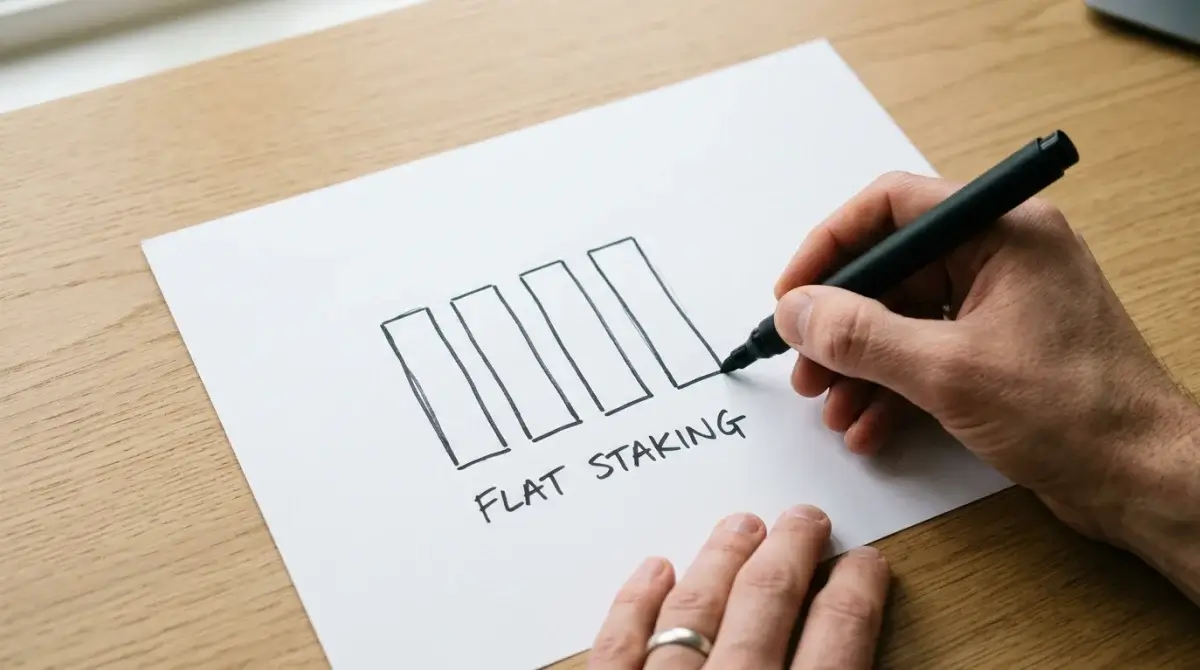
Within that one-unit baseline, I run a flat-stakes structure with limited variation. Standard bets get one unit. Picks I’d describe as my strongest reads of the slate get one and a half. Anything beyond two units is reserved for situations where I think the line is genuinely wrong — a goalie change the market hasn’t fully digested, a totals number that looks two goals off given the matchup. Those bets show up maybe three or four times a month, not three or four times a week.
What I don’t do is size by confidence on a sliding scale of five different stake levels. The honesty most bettors can’t maintain on confidence calibration makes that system a disguise for emotional staking. Two or three tiers, with strict criteria for the top tier, keeps the structure intact when you’re tilted.
The Kelly Question
Kelly criterion comes up in every bankroll conversation eventually, usually from someone who’s read about it but hasn’t run it on a hockey portfolio. The maths is sound — stake size proportional to edge — but the inputs are the problem.

To use full Kelly properly, you need an honest estimate of your edge on each bet. In hockey, where market efficiency on NHL moneylines is genuinely high and your edge on most picks is probably one to three percent rather than the ten percent you’d like to believe, full Kelly produces stakes that look about right when you’re winning and catastrophic when you’re not. The standard fix is fractional Kelly — half or quarter Kelly — which dampens the variance but also dampens any error in your edge estimate.
My honest take after years of this: most hockey bettors should treat Kelly as a thought experiment, not a staking system. It’s useful for understanding why you shouldn’t bet bigger when you think you’re sharper, because the maths shows that overestimating your edge by a few points blows up the bank faster than betting too small ever costs you. Flat one-unit staking with occasional one-and-a-half-unit increases captures most of Kelly’s benefit without exposing you to the input-error problem.
Tracking and the Numbers That Actually Tell You Something
If you’re not tracking, you’re not bankroll-managing. You’re just gambling with a budget. A spreadsheet — date, market, league, stake, odds, outcome, profit-loss — is the minimum. Anything fancier is gravy, but the basic columns let you answer the questions that matter.

The number most punters obsess over is win rate, which is the least useful metric for a hockey bettor. At average odds of 1.95 on a balanced book of moneylines and totals, you need around 52.6% to break even after the bookmaker’s hold. Win rate without average odds attached is noise. The figure I check weekly is yield — total profit divided by total stakes — because that’s what tells you whether the system is actually working.
The other number worth tracking is closing line value. Did the line move in your direction between when you bet it and when it closed? Over enough samples, beating the closing line consistently is the strongest evidence that you have an edge, regardless of short-term win-loss. A run of losing bets where you beat the close means the system is sound and the variance will turn. A run of winning bets where the line moved against you means you’re getting lucky. Hockey punishes bettors who can’t tell the difference. The principles behind NHL value betting rest entirely on this distinction.
Drawdowns, Resets and Stop-Loss Rules
The hardest part of bankroll management isn’t the maths — it’s what you do when the bank is down forty percent and every instinct is telling you to either chase or quit. Both are wrong. The plan you wrote down on day one already told you what to do, which is exactly why you wrote it down before you needed it.
My drawdown rules are simple. At twenty percent below starting bank, I review the last sixty bets in detail. Was the analysis sound? Did I beat the close? If yes, I keep going. If no, I take a week off and revisit my methodology. At forty percent down, I halve my unit size — so one percent of remaining bank, not one percent of original bank. That mechanical adjustment slows the bleeding without requiring willpower in the moment. At fifty percent down, I stop, full stop. Not for a day. For long enough to assess whether I’m playing this game well at all.

The reset isn’t a moral judgement. It’s an acknowledgement that the bettor who started the bank and the bettor who’s lost half of it might not be the same person mentally, and the second one needs a circuit breaker. Almost every long-term bettor I respect has a story about a stop-loss that, in hindsight, saved them from a much worse decision the following week.
How Discipline Looks in Practice
A normal week for me, even in a winning stretch, looks boring. Three to five bets across the NHL slate, occasionally an EIHL pick when the EIHL’s record 1,321,128 attendance season has produced enough sample for a market to be readable, and stakes that don’t vary from the plan because Tuesday’s loss doesn’t influence Wednesday’s sizing. The unglamorous middle is where the edge compounds.
The mistakes that cost money aren’t usually the bets themselves. They’re the deviations — the chase on Sunday after a rough Saturday, the double-sized stake on a “lock,” the parlay added because the singles were flat. Bankroll management isn’t a separate skill from handicapping. It’s the protective layer that lets your handicapping survive long enough to matter. Get the bankroll right and you’ve already done more than most punters will ever do to give yourself a chance.
Questions Bettors Ask About Hockey Bankrolls
What percentage of my bankroll should I bet on a single NHL game?
One percent per bet is the standard for hockey. Variance is high enough that anything above two percent exposes you to drawdowns that compound quickly. Reserve larger stakes for genuinely mispriced lines, not for picks you simply feel more confident about.
Should I use Kelly criterion for hockey betting?
Only in modified form. Full Kelly requires accurate edge estimates, and most bettors overestimate their hockey edge. Quarter-Kelly or flat one-unit staking captures most of the benefit without the catastrophic downside when your edge calculation is wrong.
When should I increase my unit size?
Only after a sustained period of positive yield across at least 200 bets, and only by a small amount relative to current bank. Increasing unit size after a hot streak is the most common bankroll mistake hockey bettors make.
Prepared by the ice Hockey Betting editorial staff.