DEL Betting Guide for UK Punters
 Available in US
Of the European hockey leagues I bet regularly, the German DEL is the one that most punishes lazy assumptions. It looks, on paper, like a slightly weaker version of the SHL — same general structure, similar import rules, comparable salary ranges. It doesn’t play like that. The DEL has its own identity, its own scoring patterns, and a market efficiency profile that catches out bettors who treat it as interchangeable with Sweden’s top division.
This guide is the one I wish someone had handed me when I started betting Deutsche Eishockey Liga games. Where the league actually sits stylistically, where UK markets misprice it, and how to build a sustainable approach without burning through a season’s worth of tuition.
Table of Contents
The Shape of the League
The DEL is the top division of German ice hockey. The current structure runs 14 teams through a 52-game regular season from mid-September to early March, followed by a pre-playoff round and then the main playoffs through April. Promotion and relegation with DEL2 was reintroduced after a long suspension, which has injected real consequence into bottom-table fixtures.

Talent-wise, the DEL sits below the SHL, Liiga and KHL in pure quality but features a strong import contingent and a growing base of German internationals who’ve stayed home rather than chasing North American minor-league deals. Several DEL alumni feature in current NHL rotations, and German hockey’s overall trajectory since the country medalled at the 2018 Olympics has been steadily upward.
For UK punters, the practical attraction is similar to the SHL: schedule alignment with European evenings, English-friendly information sources, and lines that don’t always reflect the play. The differences are stylistic, and they’re meaningful enough to require a separate mental model.
Why DEL Hockey Doesn’t Play Like Swedish Hockey
Two factors shape DEL play more than any tactical pattern. First, the import rules. DEL teams typically carry a substantial number of non-German players relative to their total roster size, and the imports tend to be high-end North American or Scandinavian forwards who play big minutes and produce the bulk of scoring. That concentrates offence on a handful of top-line players per team in a way that the SHL — with deeper domestic talent — doesn’t.

Second, the arena culture. German hockey crowds are loud, organised and consistent in a way that visibly affects home-ice advantage. Home teams in the DEL outperform their underlying expected metrics by a noticeable margin, particularly mid-table sides at packed venues. That’s a recurring pricing tension — books price moneylines based on team quality, but the home edge in the DEL is genuine and often underweighted.
The result, stylistically: DEL games are higher-scoring than SHL or Liiga matches on average, with totals lines that typically sit between 5.5 and 6.5. The reason isn’t that German teams play loose defence — it’s that the concentrated offensive talent on imports produces more chances per minute than the more evenly-distributed scoring of Swedish or Finnish rosters.
Goaltending Markets in the DEL
DEL goaltending is the second-most-volatile aspect of the league after special teams. The starter pool varies enormously in quality — some clubs run NHL-level imports, others rely on solid domestic veterans, and a handful rotate between two starters depending on form and matchup.

UK-facing sportsbooks treat DEL goaltender changes inconsistently. The 3% to 5% implied probability shift that Caesars and other US books apply to NHL starting-goalie changes shows up in DEL pricing only when the change is announced early. Late changes — confirmed within an hour of puck drop — often don’t move the line at UK books at all, which is the spot where information edges turn into actionable bets.
Where I’d be careful: DEL save-percentage data is less reliable than SHL or NHL data because the league’s variability in shot quality is wider. A goalie with a .918 over twenty starts in the DEL is not directly comparable to a .918 in the NHL, because the league’s shot mix includes more high-danger looks per minute. Treat DEL save numbers as relative-to-league rather than absolute.
Home Ice and Travel Patterns
This is the DEL edge that took me longest to internalise. Germany’s geography means most DEL clubs travel modest distances for road games, with same-day or short-flight trips the norm rather than the cross-continent slogs of the NHL. That structural difference matters: DEL teams don’t suffer the same travel-fatigue effects that produce the documented underperformance of NHL teams on second nights of back-to-backs.

But home-ice advantage in the DEL is still real and substantial, driven less by physical recovery and more by crowd atmosphere. Top venues — Eisbären Berlin, Adler Mannheim, Kölner Haie, EHC Red Bull München, Straubing Tigers — produce home environments that visibly affect officiating, momentum and visiting-team behaviour. Power-play counts skew home in these arenas in a way that translates to actual goal differential.
The implication: DEL home moneylines on top-tier clubs at top-tier venues are often shorter than they “should” be at first glance, but the underperformance against expectations is rarer than the price suggests. Don’t fade home favourites mechanically because the line looks short. Conversely, road favourites at hostile venues should be approached with more caution than the price implies.
Information Access and Lineup News
German hockey coverage in English is reasonable but uneven. The DEL’s official website carries match centres and basic statistics with English options, and several beat reporters publish in both German and English for clubs with international fan bases. Twitter is your most useful tool here — set up notifications for two or three reliable German hockey journalists and you’ll catch most lineup news 60 to 90 minutes before puck drop, which is the window UK books use to finalise prices.

Translation tools handle German cleanly. If you can’t find English coverage of a specific fixture, machine-translated German match previews and post-game analysis are usually intelligible enough to extract the relevant facts. The bigger limitation is depth — German hockey analytical coverage is thinner than Swedish or Finnish equivalents, with less publicly available expected goals data and shot-quality breakdown.
Markets Worth Playing
The DEL markets I’ve had sustained success in: regulation moneyline on home favourites against bottom-table road sides, where the home-ice effect compounds with team quality; totals on matchups featuring two high-import-scoring teams, where the concentrated offence drives totals over the 5.5 line more often than the price suggests; goalie save totals when a known shot-volume team visits, particularly mid-week.
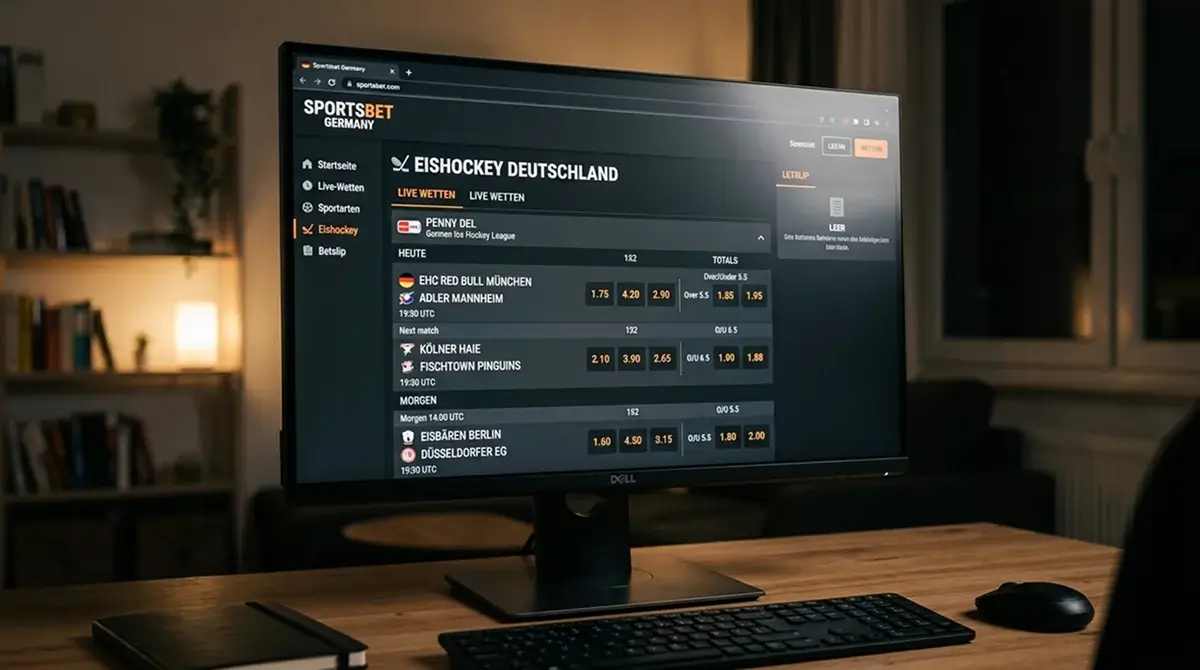
Markets I treat carefully: 3-way moneyline (regulation only), because the higher-scoring nature of the DEL means games tied through 60 minutes are less common than in the SHL or Liiga, which compresses the value on draws and makes the maths trickier. Player props on third-line domestic forwards, where ice time is unpredictable. In-play markets, where UK book pricing lags badly behind actual game state.
The cross-pollination with other European leagues is worth thinking about for portfolio reasons. If you’re already betting the SHL and Liiga, the DEL doesn’t just give you more games — it gives you a stylistically different product. Understanding home-ice advantage in hockey at a league-specific level is genuinely valuable across these markets, because the size of the effect varies more than most punters realise.
The Playoffs: Where the DEL Earns Its Identity
DEL playoffs run with a pre-playoff round seeding the top-eight bracket — a structural quirk that makes round-one matchups less predictable than in leagues with straightforward eight-team brackets. The Deutsche Meisterschaft (German Championship) has been won by a rotating cast of top clubs in recent years, with no single dynasty dominating the way SKA or CSKA does in the KHL.

Playoff betting in the DEL rewards bettors who pay attention to seeding paths and rest differentials. Teams that emerge from the pre-playoff round arrive at the quarterfinals with momentum but also with fatigue, and the trade-off doesn’t always price into futures markets. Series-length and total-games markets often offer more value than direct championship futures, because the bracket structure produces more variance in path-to-final than the moneyline odds reflect.
The DEL Bettor’s Mindset
The bettors I know who do well on the DEL share two traits. They’ve watched enough games to recognise the league’s pace and structure without needing to consult the box score, and they treat the DEL as its own product rather than a junior version of the NHL or a German clone of the SHL.
Smart money on the DEL is smaller money than in the NHL, but it’s also more concentrated in the hands of bettors who actually know the league. UK casual money is thin enough that the recreational-vs-sharp dynamic plays out differently — there’s less recreational money padding the lines, but the sharp money that’s there knows what it’s doing. The opportunity is in the lag between information and price, not in fading public sentiment.
If you’re starting out, do what I did backwards: pick three clubs across different table positions and watch them through October and November before betting anything beyond small token stakes. By December you’ll have a real read on the league’s rhythm, and the markets will be there for the rest of the season.
Common Queries on DEL Wagering
Are German DEL games available at UK sportsbooks?
Yes, at most UKGC-licensed bookmakers covering European hockey. Moneylines and totals are standard, with deeper markets available on top fixtures involving major clubs like Eisbären Berlin, Adler Mannheim and EHC Red Bull München.
Why are DEL totals higher than SHL or Liiga totals?
German hockey concentrates offensive talent on top-line imports more than Swedish or Finnish leagues do, which produces higher scoring rates per game. The structural concentration of talent — not loose defence — is the main driver.
Does home-ice advantage matter more in the DEL than other leagues?
The DEL’s strongest home venues produce a noticeable crowd-driven home edge, particularly in power-play counts and momentum swings. The effect is stylistically different from travel-fatigue patterns in the NHL and worth pricing in when evaluating moneylines.
Published by the ice Hockey Betting team.