Live and In-Play Ice Hockey Betting
 Available in US

The market that ate hockey betting
Ten years ago, an NHL Saturday for a UK punter meant locking in pre-match bets and watching the games with the lines closed. That world is gone. Today the same punter has a phone in one hand, a sportsbook app showing live puck line at 2.30 with eight minutes left in the second period, and an option to hedge a pre-match position before the third even starts. The live market has become the dominant product, and it is reshaping how serious punters approach hockey.
The numbers tell the story. In-play wagering accounts for more than 60% of US regulated sportsbook handle, and the UK market follows the same direction. UK books invest heavily in live odds engines, low-latency feeds, and the cash-out features that keep punters engaged through every period change. The pace of the product has accelerated to the point where any UK punter not paying attention to live markets is leaving meaningful equity on the table.
This guide covers the structure of live ice hockey betting from a UK punter’s perspective — share of volume, intermission markets, live puck line and totals behaviour, the latency problem and the bankroll discipline you need to survive the speed.
Live volume and why it matters
The shift in handle from pre-match to live has changed how books price every market. When 60% of money flows through in-play, the pre-match line becomes less critical to the book’s overall margin — they can afford a tighter pre-match juice because the post-puck-drop window will provide additional balancing opportunity. This is genuinely good news for disciplined pre-match punters, but it also means the books are pouring resources into making live odds sharper, faster and more accurate.
For the UK punter, the practical implication is that live markets are the sharpest products in hockey by a wide margin. The juice on a live moneyline mid-period might be tighter than the pre-match version, but the line is also updating every shift to reflect the score, the shot count, the goaltender’s recent saves, and the time remaining. There is less room for the kind of stale-price arbitrage that used to define live betting in slower products.
What still exists is opportunity around discrete events. A goal scored produces a price freeze, then a snapped reopening at a new number. A penalty produces immediate repricing on totals and short-term game-state markets. An empty-net pull at 90 seconds left produces a flurry of micro-markets that can be exploited if you have a thesis ready before the situation arises.

Intermission markets in UK prime time
NHL games typically kick off at midnight UK time during the regular season, which makes the third-period intermission window the most UK-relevant trading moment of the night. By the second intermission, the game has 20 minutes of regulation left, the score is established, the goaltenders are in or out of rhythm, and live markets settle into a brief lull before the third opens.
This is the cleanest live window for UK punters because the pricing is more rational than mid-period live markets. The book has roughly 16 minutes (the intermission plus warm-ups) to update odds with no live event pressure. The market reflects considered numbers rather than reactive ones. If you have a third-period thesis — pace expectation, pulled-goalie likelihood, late-game empty-net scenario — the intermission window is when you act.
The most-traded intermission products are third-period winner, third-period total goals, and final result given current score state. The third-period winner market is particularly interesting because it strips out everything that has already happened — you are betting only on the final 20 minutes, with the score reset to 0-0 for grading purposes. That separation removes the cognitive bias of “they were better in the first two periods” and forces you to evaluate just the closing stretch on its own merits. The same usage and matchup logic that drives ice hockey player props applies here in compressed form.

Live puck line and totals behaviour
Live puck line is where the empty-net dynamics get most interesting. A favourite at -1.5 pre-match might lead 2-1 with five minutes left and trade at 2.10 in-play. The book is pricing in the genuine possibility of a late equaliser, but also the empty-net cushion that comes with a leading team pulling against the trailing side’s net. Punters who have not internalised the empty-net asymmetry tend to underweight the -1.5 ticket at this stage; punters who track the data overweight it.
Live totals follow a predictable pattern. A 6.0 pre-match total drops to 4.5 after a scoreless first period. It drops to 3.5 if the second period also ends scoreless. The over price compresses as the time runs down, and the under price extends. The disciplined live total bet looks for moments where the line has overshot expectations — typically after a quiet stretch that the book has interpreted as evidence of a defensive game, when in reality the matchup data suggests scoring is coming.
The latency factor matters here. Live total adjustments can take 30-60 seconds to reprice after a goal. UK punters with sharp feeds and quick reactions have a small window to catch the stale price; punters relying on the sportsbook’s own broadcast feed face a meaningfully delayed reaction. The structural disadvantage is real, and it is one reason most casual UK live total bettors lose over time.
The latency and line-freeze problem
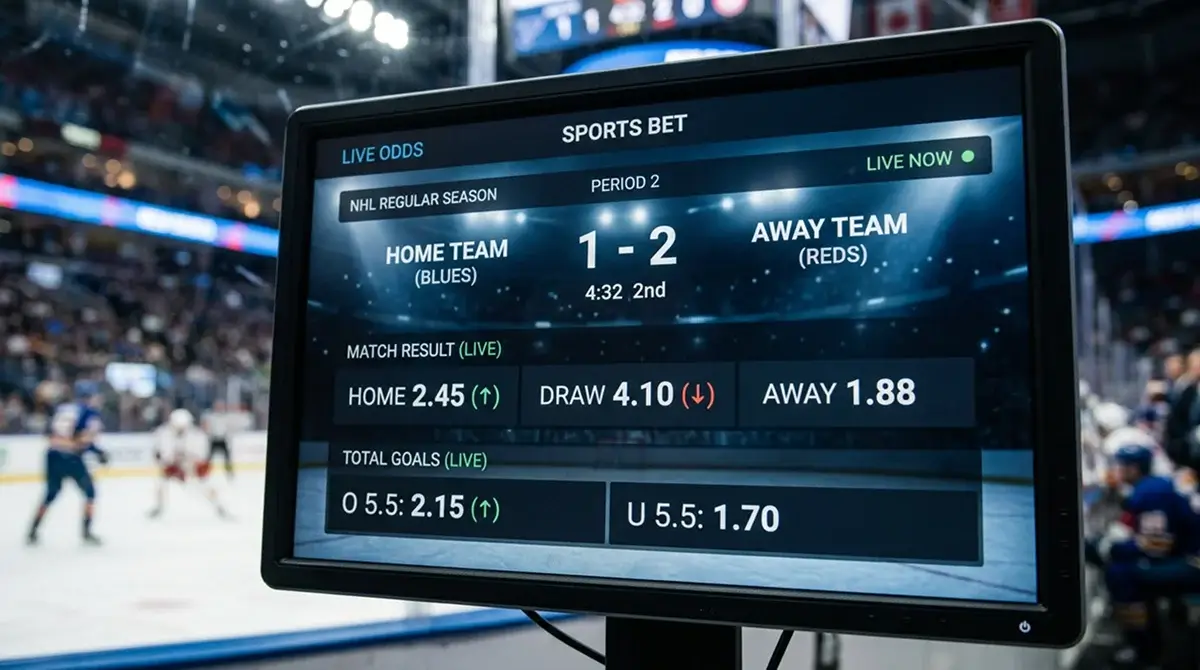
Live markets do not run as a continuous stream. They freeze on discrete events — goals, major penalties, video reviews — and reopen at adjusted prices. The freeze duration varies by book and event: a goal might lock the market for 15-30 seconds, a video review for 60-90 seconds, a coach’s challenge for 90-120 seconds.
The structural issue for UK punters is that the live feed driving your home viewing is typically delayed by 20-60 seconds compared to the data feeds the book uses to price markets. You see the goal go in on TV after the book has already frozen the market and is in the process of repricing. By the time the market reopens, the public has had time to react and the price reflects the new reality.
This is amplified by the fact that 95% of UK online gambling activity happens from home, with 76% of 18-24 year-old players betting from mobile devices. The home setup with cable or streaming TV produces the highest latency between event and visible action. Some punters work around this by using lower-latency streaming services, dedicated NHL Live subscriptions, or by following sharp live-betting Twitter accounts that broadcast the event microseconds after it occurs. None of these workarounds fully close the gap, and the structural latency tax remains a meaningful disadvantage on live betting.

Bankroll discipline at live speed
The danger of live betting is not the markets — it is the pace. A 60-minute NHL game can present a punter with 30-50 separate decision points if they are watching micro-markets and prop adjustments. Each decision feels small and isolated, but the cumulative effect on bankroll can be catastrophic for punters without strict pre-game limits.
The discipline that has worked for me: define a single live-betting budget per game before puck drops. Treat it as a separate stake bucket from pre-match bets. When the budget is exhausted, the live session ends, regardless of how attractive the next price looks. This rule prevents the chase dynamic that destroys most live bettors — the “one more bet to recover” pattern that turns a single bad sequence into a deep loss.
The other discipline is unit sizing. Live bets need smaller stakes than pre-match bets, not larger ones. The variance is higher, the information edge is narrower, and the speed of decision-making rewards smaller stakes that allow more iteration. A pre-match unit of 1% of bankroll should typically become a live unit of 0.3-0.5%. Punters who use the same unit size pre-match and live tend to blow through bankrolls on bad weeks because the live market gives them more opportunities to compound losses.

Treating live as a focused discipline
Live ice hockey betting is the fastest, sharpest and most demanding product on the UK board. Its growth is real and its margins for the punter are genuinely tighter than they used to be — but only for the disciplined operator. Casual live betting at full stakes through 60 minutes of NHL is one of the highest-loss patterns I see in punter logs.
The framework that works: pick specific live windows where you have a real thesis (intermission, late-game empty-net, post-penalty totals), bet smaller stakes than pre-match, and accept the latency disadvantage as a structural cost. Treat the rest of the live experience as entertainment rather than as an extension of your betting strategy. That separation is what keeps live betting in its proper place.
How long does a live NHL market freeze after a goal?
Most UK sportsbooks freeze the moneyline, puck line and totals markets for 15-30 seconds after a goal is scored. Player prop markets typically freeze longer — 60-90 seconds — to allow recalculation of remaining scoring probabilities. Video reviews extend the freeze to 60-120 seconds. The exact timing varies by book, and faster books reopen markets sooner, which can be a small competitive edge if you have multiple accounts open.
Why does the live total drop more after period one than after period two?
After period one, the book is repricing the remaining two periods based on the pace established. A scoreless first period typically drops the live total by 1.5-2.0 goals because the book reads it as evidence of a defensive game. After period two, the book is repricing only the remaining 20 minutes plus potential OT, so the proportional adjustment to a quiet second is smaller — typically 0.5-1.0 goals.
Are live moneyline odds in EIHL typically wider than NHL?
Yes, noticeably wider. EIHL live markets carry 6-8% combined hold on moneyline compared to NHL’s 4-5%. The data feeds are thinner, the book’s internal models less refined for EIHL, and the public volume to balance against is much smaller. The wider juice reflects genuine pricing uncertainty as well as the lower competitive pressure between books on EIHL coverage.
Prepared by the ice Hockey Betting editorial staff.