Liiga Betting Guide for UK Punters
 Available in US
The most disciplined hockey league I bet regularly is Finnish. I came to Liiga by accident a few seasons ago when an NHL slate ran thin on a Wednesday and I scrolled down the bookmaker’s menu until I found something to look at. What I found has stayed in my weekly routine: a league that plays a tight, defensively-organised brand of hockey, with markets that UK-facing sportsbooks treat as an afterthought. That combination — tight hockey, lazy pricing — is exactly the environment where careful bettors find edges.
This guide covers the Finnish Liiga from a UK punter’s perspective: how the league actually behaves, where the typical mispricings sit, and how to approach the markets without falling into the traps that catch bettors who treat all European hockey as interchangeable.
Table of Contents
- Where Liiga Sits in European Hockey
- The Style That Defines the League
- Goaltending: Liiga’s Calling Card
- Information Sources for English Speakers
- Market Selection: Where to Bet, Where to Skip
- Variance and the Long Season
- The Playoffs: Different Animal
- Putting Liiga Into Your Weekly Rhythm
- Common Questions on Finnish Hockey Betting
Where Liiga Sits in European Hockey
The Finnish Liiga is the top professional league in Finland. It runs 15 teams through a 60-game regular season, starting in mid-September and concluding in March, followed by playoffs through April. The league produces a steady flow of NHL talent — goaltenders particularly — and retains a dense base of Finnish internationals plus a meaningful import contingent from Sweden, Czechia and North America.

The talent ceiling sits below the SHL and KHL but the depth is consistent. There’s no Liiga equivalent of an SKA Saint Petersburg dominating the league; competitive balance is genuinely tight, with the bottom seed in most playoff years still capable of pushing the top side to six games. For betting purposes, this matters. Liiga moneylines tend to be more compressed than other European leagues — fewer heavy favourites, more pick-em situations, more value in pricing-flow analysis rather than picking obvious winners.
The Style That Defines the League
Finnish hockey is the most structurally-disciplined I bet. Teams play heavy systems, prioritise defensive shape, and grind possession in the neutral zone rather than chasing transition offence. Coaches drill specific roles into players from junior level, and that systemic training shows up in how teams behave when leading by a goal in the third period — they don’t panic, they don’t open up, and they don’t trade chances.

What this produces statistically: totals lines that sit between 4.5 and 5.5, similar to the SHL but with even less variance around the midpoint. Goal distributions cluster more tightly. Empty-net goals at the end of games make a larger percentage of total goals scored, because the actual five-on-five play stays low-event for most of the match.
The favourite-longshot bias that NHL bettors exploit on totals — the Woodland and Woodland finding that NHL unders carry value because casual money piles on overs — doesn’t transfer to Liiga in the same way. The market for Finnish hockey is dominated by sharper money relative to recreational money, partly because the league has less casual following outside Finland. Lines reflect the league’s true scoring patterns more honestly than NHL totals do, so don’t bet unders mechanically.
Goaltending: Liiga’s Calling Card
Finland exports goaltenders. The current generation of NHL netminders includes several Finnish names at the very top, and the production line keeps replenishing through Liiga’s youth pipeline. The implication for betting is straightforward: goaltending in Liiga is generally excellent at the starter level, but the gap between starters and backups is wider than in higher-budget leagues because teams concentrate ice time on their number-one.

Goalie change pricing in Liiga is genuinely sloppy at UK books. Sportsbooks like Caesars apply a 3% to 5% implied probability shift to NHL starting-goalie changes consistently. Liiga sees the same structural impact in actual game outcomes but the market response is delayed and often incomplete on UK-facing platforms. If you can establish before puck drop that a starter is being rested and a backup is going — particularly on back-to-back nights — and the moneyline hasn’t moved, that’s a workable spot.
Where this gets interesting is on totals. A backup goalie can drag a 5 total to a 6 in implied scoring expectation, but UK markets often won’t move the line at all on that information. The over isn’t always the right bet, because the backup might still get bailed out by his defence in a 4-3 game, but the price you’re getting on the over reflects starter expectations, which is the value.
Information Sources for English Speakers
Finnish-language hockey coverage is the deepest and most analytical of any European league. The frustration for UK punters is that translation tools handle Finnish less smoothly than Swedish or German, and the cultural references in Finnish sports media are harder to navigate without context.

What works: the official Liiga website carries English-language sections with results, standings, basic stats and limited player information. Team social media accounts often post key updates in English alongside Finnish. There’s a small but active English-language Finnish hockey community on Twitter and YouTube that covers the league seriously. Set up notifications for two or three reliable accounts and you’ll have most of what you need.
What doesn’t work: relying purely on data feeds. Liiga box scores update with a lag at most UK sportsbooks, and pre-game lineup confirmations are inconsistent. If a fixture starts at 18:30 Helsinki time, the official lineup might not be posted until 17:30 local — which is 15:30 GMT — and books that take Liiga action don’t always wait for that confirmation before publishing prices. The window between confirmed lineup and price update is where edges live.
Market Selection: Where to Bet, Where to Skip
Liiga markets at UK books are functional but shallow. Moneyline, totals, period markets and a handful of player props on top games. Don’t expect Premier League depth. The advantage of that shallow market is that the lines themselves tend to be less efficient — there’s less sharp action shaping the price.
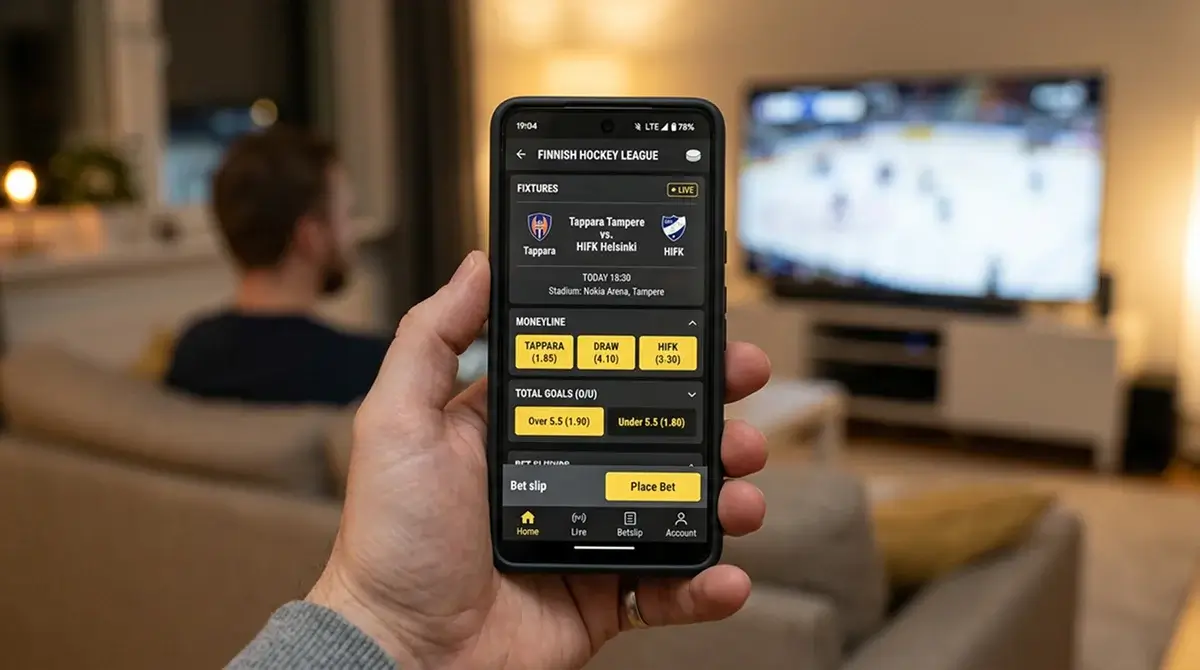
Markets that work for me: regulation 3-way moneyline on tight matchups, where the Finnish tendency to settle games in 60 minutes through structured defence is underpriced. Team totals on home favourites against bottom-table opposition. First-period unders, which align with the slow-starting nature of Finnish hockey. Goalie save totals when the matchup suggests a shot-volume game.
Markets I avoid: in-play moneyline on Liiga games, where the lag between match action and price feed is sometimes 20 seconds or more — that’s an eternity in hockey betting. Same-game parlays with multiple Liiga selections, which are correlated more tightly than the price suggests because Finnish games tend to flow as either low-event grinds or rare track meets, not somewhere in between. Long-shot futures on dark-horse playoff contenders, which look attractive in November but require multi-month patience that the playoff format doesn’t always reward.
Variance and the Long Season
Sixty regular-season games is short by NHL standards but long enough that the cream rises. The Liiga regular season is genuinely competitive at the top — usually three to five teams can win the championship in any given year — but the bottom of the table sorts itself out by January. By February, the playoff seeding becomes the main betting story, with teams jostling for positioning rather than mathematical survival.
This is where small staking discipline pays. Hockey bettors who survive long enough to capture an edge are the ones who treat each Liiga bet as part of a long campaign, not as a one-off. The principles behind sensible bankroll management for hockey betting matter more in markets like Liiga, where stake sizing should be conservative because liquidity won’t support aggressive sizing anyway.
The Playoffs: Different Animal
Liiga playoffs tighten further than the regular season. Goal totals drop. Discipline tightens. Series often produce one or two games that finish 1-0 or 2-1 even when neither team has elite goaltending — that’s just the way Finnish hockey behaves when the stakes go up.

Futures pricing for the Mestaruus (Finnish championship) is tighter than equivalent NHL Stanley Cup futures because the field is smaller and the favourites repeat from year to year. Tappara, Ilves, Kärpät, JYP and HIFK have all been recent factors at the top of the table, and the market knows it. Where playoff value appears: series-length markets, total-rounds markets, and “team to make the final” propositions that don’t perfectly mirror the moneyline futures.
Putting Liiga Into Your Weekly Rhythm
The pitch for Liiga as part of a UK hockey portfolio isn’t that it offers a secret edge no one’s spotted. It’s that the league is sharply played, the lines are softer than the play suggests, the schedule fits UK afternoons and early evenings, and the markets reward bettors who do the work. Finnish hockey doesn’t pretend to be anything other than what it is — disciplined, low-event, structurally sound — and bettors who match that approach with their own discipline tend to do well.
Start small, watch enough games to recognise the systems, and don’t bet futures until you’ve seen at least a half-season of regular play. The Liiga will be there next year, and the year after. There’s no rush.
Common Questions on Finnish Hockey Betting
Is the Finnish Liiga widely covered by UK sportsbooks?
Top Liiga fixtures appear on most UKGC-licensed bookmakers with moneylines, totals and basic period markets. Player props and in-play markets are less consistent and shouldn’t be assumed available.
Why are Liiga totals so much lower than NHL totals?
Finnish hockey plays a more structured, lower-event style than NHL hockey. Teams prioritise defensive shape over offensive chance creation, and the league’s totals lines reflect that genuine scoring difference rather than a market bias.
How can a UK bettor follow Liiga without speaking Finnish?
The official Liiga website carries English-language sections, several team accounts post in English alongside Finnish, and a small but active English-language community covers the league online. Translation tools handle Finnish less smoothly than Swedish, so direct news sources are more reliable than translated text.
Prepared by the ice Hockey Betting editorial staff.