
NHL Moneyline Betting: How 2-Way Pricing Works
 Available in US

Table of Contents
The market hockey punters underrate
Ask a UK punter to describe their bread-and-butter hockey bet, and nine out of ten will say puck line or totals. Moneyline gets dismissed as boring — the bet you place when you cannot be bothered to think. That dismissal has cost me a small fortune to overhear and unlearn over nine years of running NHL slates.
Moneyline is the cleanest product hockey offers. You pick a winner. The game lasts as long as it needs to. OT counts, the shootout counts, and the only complication is whether your sportsbook treats it as a 2-way market (which UK books almost always do) or a 3-way market with the regulation tie priced separately. The simplicity is what makes it valuable. There is nothing fiddly to misread, no half-goal trap, no late empty-netter to ruin a winning thesis.
This piece walks through how 2-way NHL moneylines are priced for UK punters, how implied probability translates into decimal odds, why favourites drift in particular patterns, and where the goaltender effect lurks behind every quoted number.
The 2-way line includes overtime and shootouts
Walk into a UK-licensed sportsbook tomorrow and the NHL match page will show two prices: home team to win, away team to win. That is it. No tie option. No regulation-only filter. The bet stays alive through 60 minutes, through 5-on-3 overtime if needed, and into the shootout if regulation ends level.
This matters because around a quarter of NHL regular-season games go beyond regulation. The 5-minute 3-on-3 overtime period and, if needed, the shootout, are part of the bet you placed. If your team scored an OT winner, you collect. If they lost the shootout, you do not. The mechanics are stitched into the product before the puck drops.

The 2-way framing is the UK default. American books sometimes split the market into regulation moneyline and 60-minute moneyline as separate bets, but UK customers see the unified product on virtually every operator. That uniformity has a side effect: pricing pressure is concentrated on one line per team, which keeps the juice tighter than fragmented markets.
From implied probability to UK decimal odds
Every moneyline price is an implied probability dressed up as a number. A favourite quoted at 1.50 in decimal odds is the book saying “we think this team wins about 67% of the time.” The maths: implied probability equals 1 divided by the decimal odds. A 2.50 underdog clocks in at 40%. Add the two implied probabilities on a real market and you will land at 103-105% instead of 100% — that overround is the book’s margin.
Where it gets interesting for hockey is the goaltender wedge. Karry Shreeve at Caesars Sportsbook has been the most quoted authority on this for the last few years, and his number is one I run my own models against: a starting goaltender change typically shifts implied probability by 3-5 percentage points. Map that onto a moneyline at 1.65 (roughly 61% implied) and a backup-goalie reveal pushes the price out toward 1.85 or 1.90. That is not a rounding adjustment — it is a genuine market move you can see at warm-up.
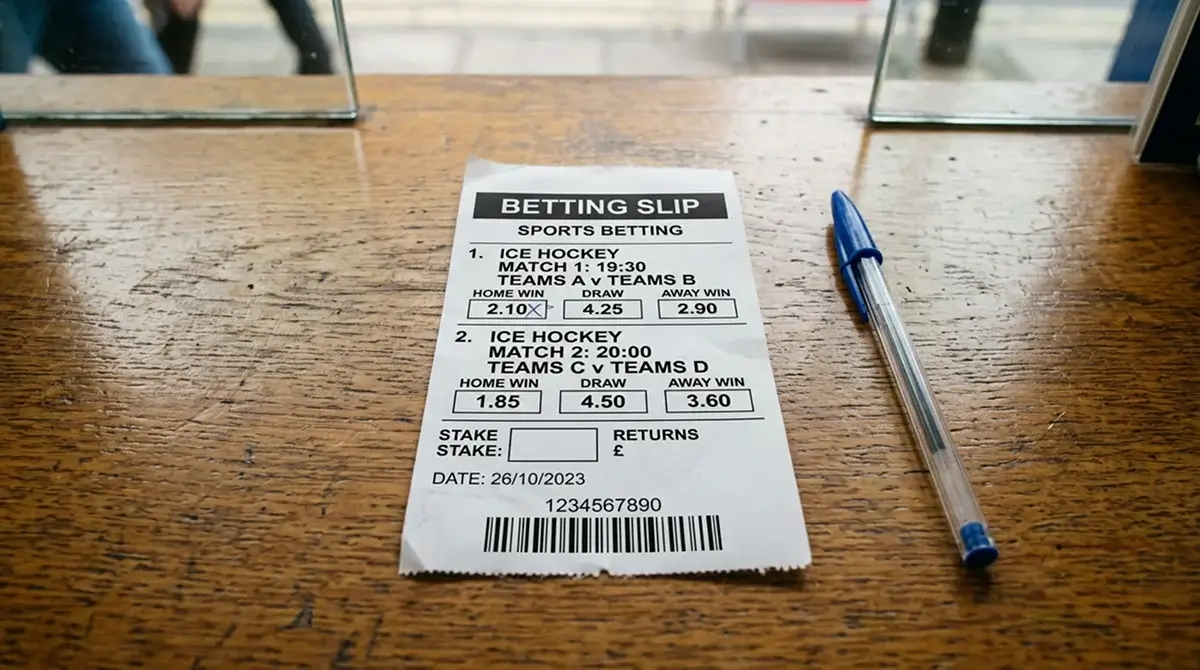
UK decimal makes the maths neater than American odds. To convert: decimal odds minus 1 gives you the profit per pound staked at evens. A 1.85 ticket pays 85p profit on a £1 stake. A 2.30 ticket pays £1.30. No fiddling with +110 and -150 conversions. The clarity helps when you are running stake-sizing across multiple games on a busy NHL Saturday.
Why favourites and underdogs price differently
Hockey moneyline economics are not symmetric. A -200 favourite (1.50 decimal) and a +200 underdog (3.00 decimal) do not behave like mirror images, and the books know it. The favourite carries lower variance, higher stake volume, and more public money. The underdog attracts sharps, value hunters, and the occasional desperate parlay leg.
This is most visible in futures markets. When the 2025/26 Stanley Cup boards opened, the joint favourites on BetMGM were Colorado Avalanche at +135 and Carolina Hurricanes at +165 in American odds, which converts to 2.35 and 2.65 in UK decimal. The shape of the futures market — two clear favourites at modest plus money, then a stack of mid-tier names at 8.00 to 15.00, then a long tail of longshots — reflects how the public bets the moneyline within individual games as well. People stack the favourites and snipe the longshots, and the books price accordingly.
For game-level moneylines, the practical insight is that favourites at 1.50 to 1.70 see the heaviest action and tightest pricing. Move into the 2.00 to 2.50 range — the “small favourite” or “mild underdog” pocket — and the juice often widens because volume drops. That mid-range is where I look for the cleanest entry points, particularly when the underdog has a confirmed starting goalie and the favourite is on a back-to-back.
Underdog drift is another quirk. A 2.40 underdog at opening will often drift to 2.60 or 2.70 by puck drop if the public chases the favourite. That movement is rarely sharp action — it is the book balancing exposure. If your thesis on the underdog is solid, the closer to puck drop you bet, the better the number tends to be.

Goaltender swings hidden inside every price
I keep returning to goaltenders in moneyline coverage because they are the most consistent source of mispricing I see at UK books. A late goalie change can shift the moneyline by 0.15 to 0.25 in decimal terms — sometimes more if the announced backup is a third-string call-up.
The window for this is narrow. Most books update their moneyline within minutes of warm-up news, and the social media accounts that break it move quickly. UK punters working London or Manchester evening hours often have the advantage of catching late North American announcements while books are slower to react in off-peak hours. I have seen prices stay stale for 10-15 minutes after a confirmed backup start, particularly on midweek games that draw less attention.
The reverse situation — confirmed Vezina-quality starter when the books had priced in tandem split risk — is rarer but equally tradable. When a top-tier goalie is locked in, the moneyline often tightens by 5-10% in the favourite’s direction. Catching the price before that adjustment is one of the cleanest +EV entries in regulated hockey markets.

Moneyline against puck line: which to take
The constant comparison in hockey betting is moneyline against puck line. The trade-off looks like this: take the moneyline at shorter odds with higher win probability, or take the puck line at longer odds and accept the goal-margin risk. The right answer depends entirely on your thesis.
If your view is “this team wins, possibly narrowly” — moneyline. If your view is “this team wins comfortably because the opposing goalie is a sieve tonight” — puck line at -1.5. If your view is “this team probably loses but will keep it close” — puck line at +1.5. The moneyline lives in the centre of those three theses; the puck line splits the favourite-blowout and underdog-cover scenarios into their own products.
The economics also depend on the moneyline price. A favourite at 1.40 is unattractive on the moneyline (small return, no margin for error) but can be appealing at -1.5 puck line at 2.20 if you believe the opposing backup is starting. A favourite at 1.95 is the inverse — the moneyline number is already generous, so paying the variance tax for -1.5 is rarely worth it. For a deeper breakdown of the puck line side of this trade, see the puck line betting explained guide.

Treating the moneyline as the default
The discipline I would give any UK punter starting on NHL is to make the moneyline your default and force every other market to justify the swap. Puck line needs a goaltender thesis. Totals need a pace thesis. Props need a usage thesis. The moneyline only needs you to be right about who wins. That simplicity is not boring — it is the cleanest expression of an opinion you have on a hockey game.
Once you start running results, the moneyline also gives you the cleanest record. Closing line value is easier to track. Stake sizing is more consistent. And the OT/shootout swing, while occasionally painful, evens out across a season of bets.
Are NHL moneylines always quoted in decimal at UK sportsbooks?
Yes. Every UKGC-licensed sportsbook displays moneyline odds in decimal by default for UK customers, with fractional available as a toggle on most sites. American odds are rarely shown in UK interfaces — you would need to switch your account region to see them, and they offer no practical benefit for UK punters working out stakes in pounds.
Why do moneyline favourites drift more sharply at -200 than at -120?
At -200 (1.50 decimal) the book is taking on heavy exposure with limited upside if the favourite wins. Public money piles on heavy favourites, which forces the book to adjust the line to balance liability. At -120 (1.83 decimal) the book has more breathing room because the public stake is smaller and the implied probability gap to the underdog is narrower. Sharp action also targets the mid-range more often, keeping it tighter.
Is the 2-way NHL moneyline graded on OT and shootout outcomes?
The 2-way moneyline is graded on the final result regardless of how the game ends. Overtime winners count, shootout winners count. The only way a 2-way moneyline ticket gets graded as a push is if the game is officially suspended and not completed — extremely rare in the modern NHL. If you want the regulation-only outcome priced separately, you need the 3-way moneyline market, which is a different product.
Written by the editors at ice Hockey Betting.